




Melba Liston
By: Jeff Peckham
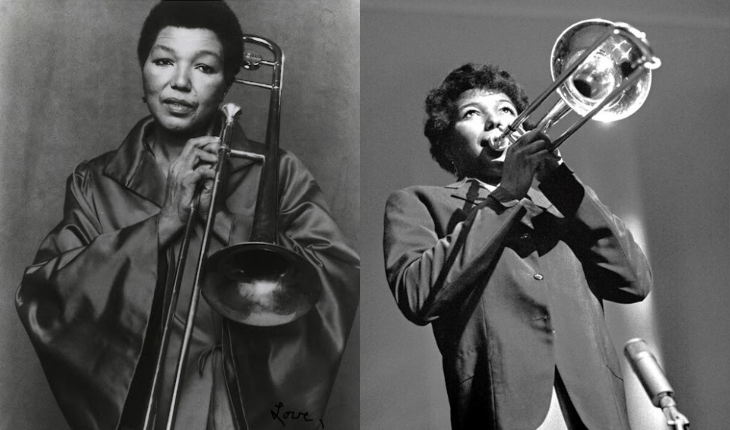
Melba Liston (1926–1999) was a titan of jazz whose contributions as a trombonist, composer, and arranger fundamentally reshaped the sound of the big band era and beyond. As the first woman to hold a chair in several of the world’s most prestigious jazz orchestras, she broke formidable gender and racial barriers, proving herself a “Renaissance woman” of the genre.
Early Life and Career
Born in Kansas City, Missouri, Liston was mesmerized by the trombone at age seven, allegedly seeing one in a shop window and feeling an immediate connection. Largely self-taught, she was performing on local radio by age eight. After moving to Los Angeles in 1937, she joined the pit band at the Lincoln Theater and eventually the Gerald Wilson Orchestra in 1943. Her early career was marked by brilliance but also by the harsh realities of the road; a grueling tour with Billie Holiday in the segregated South in the late 1940s was so traumatic that Liston briefly left music to work for the L.A. Board of Education.
Notable Collaborations and Mastery
Liston’s career is defined by her work with the architects of modern jazz. She was a favored collaborator of Dizzy Gillespie, joining his bebop big band in the late 1940s and again for high-profile State Department tours in the 1950s. Her deep, lyrical trombone tone and sophisticated arrangements became a hallmark of the Gillespie sound. She also worked extensively with Count Basie, Quincy Jones, and Duke Ellington.
However, her most profound partnership was a four-decade collaboration with pianist Randy Weston. Often compared to the telepathic relationship between Duke Ellington and Billy Strayhorn, Liston served as the primary architect for Weston’s orchestral visions, blending his percussive piano style with rich, complex brass textures.
Emblematic Compositions and Recordings
While Liston recorded only one album as a leader, the 1958 classic Melba Liston and Her ‘Bones, her fingerprints are all over the jazz canon. Her most significant works include:
Impact and Legacy
Beyond her technical prowess, Liston’s impact on jazz was revolutionary. She proved that a woman could not only compete in the male-dominated “inner circle” of jazz but lead it from the arranger’s desk. Her style—characterized by thick harmonic voicings, an expert use of dissonance, and a seamless blend of blues and bebop—influenced generations of orchestrators, including Maria Schneider.
In her later years, even after a stroke in 1985 left her partially paralyzed, she continued to compose using computer technology. In 1987, she was named an NEA Jazz Master, the highest honor in American jazz, cementing her status as a pioneer who, in her own words, had to “prove herself like Jackie Robinson” to ensure that the voice of the woman instrumentalist would never again be silenced.