




Third Stream Music — The Hybrid Intruder
By: Michael Skattebo
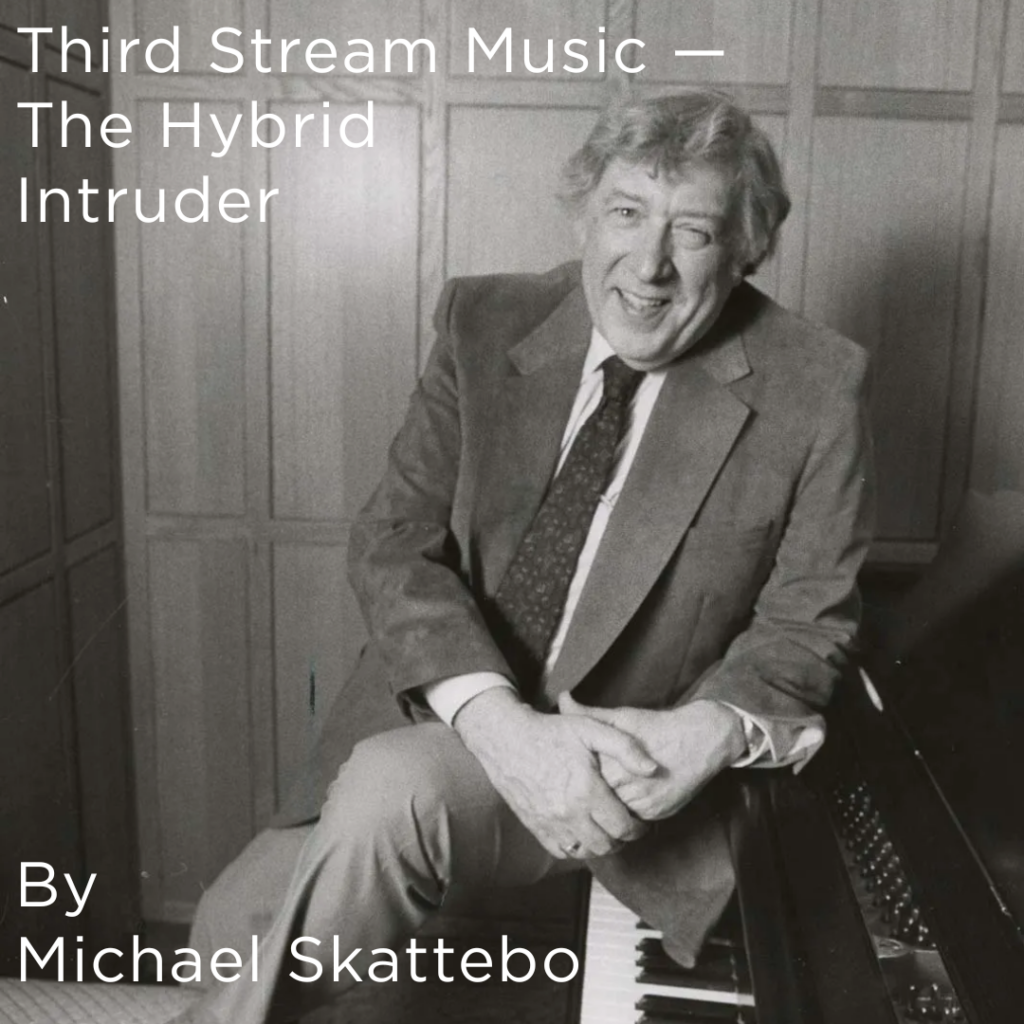
Fusion in art often divides as much as it inspires. What some welcome as innovation, others see as an existential threat to tradition. It was with this tension in mind that American composer Gunther Schuller coined the term Third Stream — the merging of jazz and classical currents into a new musical confluence. But Schuller’s intent in coining the term in 1957 wasn’t to herald the arrival of something new, but rather to finally recognize the entanglement of jazz and classical music that had begun to occur decades before.
In Schuller’s eyes, the beginnings of this cross-pollination began to take shape when jazz was first introduced to Europe by touring American bands at the close of World War I. With a taste and vague familiarity for this new music established by the early 1920s, the next step came when European composers (most notably Darius Milhaud) traveled to Harlem to experience ‘the real thing’ firsthand. After his visit in 1922, Milhaud returned to France with an unshakeable, rhythmic virus that inspired the music of his ballet La Crétion du monde, often considered one of the first compositions to intentionally unite the jazz and classical traditions of the time.
Milhaud’s response was hardly isolated, as throughout the 1920s composers like Aaron Copland and George Gershwin pursued similar entanglements with jazz, reinforcing this new current that shaped the decade’s sound. Yet for all its vitality and innovation, this music remained carefully composed — drawing from jazz’s rhythms and colors without embracing its improvisational core.¹
By the 1950s, Schuller sought to move beyond mere stylistic borrowing and toward a music that fully combined the compositional rigor of classical music with the improvisational freedom of jazz — a philosophy and new genre he called Third Stream. Energized by this vision, he began commissioning works from young musicians and composers who embraced these principles. Schuller worked closely with John Lewis of the Modern Jazz Quartet and presented performances by George Lewis, Jimmy Giuffre, J.J. Johnson, and Charles Mingus that exemplified this new approach. While fully embraced by the musicians themselves, Third Stream music was extremely controversial, with critics from both jazz and classical circles perturbed by what they called the hybrid intruder. Jazz critics were particularly harsh, insisting that this music threatened tradition and judging it solely by jazz standards — that is, did it swing?
In response to the outrage, Schuller often made public addresses and included disclaimers in the liner notes of his records to clarify his intentions to respect the history and values unique to the jazz and classical lineages. In 1961, Schuller wrote:
I am fully aware that, individually, jazz and classical music have long, separate traditions that many people want to keep separate and sacred. I also recognize the right of musicians in either field to focus their attention entirely on preserving the idiomatic purity of these traditions.
It is precisely for these reasons that I thought it best to separate from these two traditions the new genre that attempts to fuse the improvisational spontaneity and rhythmic vitality of jazz with the compositional procedures and techniques acquired in Western music during 700 years of musical development.
I felt that by designating this music as a separate, third stream, the two other mainstreams could go their way unaffected by attempts at fusion. I had hoped that in this way the old prejudices, old worries about purity of the two main streams that have greeted attempts to bring jazz and “classical” music together could, for once, be avoided. This, however, has not been the case. Musicians and critics in both fields have considered this Third Stream a frontal attack on their own traditions.²
Ironically, in coining the term Third Stream, Schuller created a “genre” in order to escape the confines of genre. His goal was never to establish a new category for its own sake, but to allow the music to be judged on its own merits — neither as jazz nor as classical. In his own words, “it would be best to forget all labels and categories, to approach these pieces simply as ‘a music written today.’”³ By naming the movement, Schuller provided a framework for audiences and critics to engage with the work seriously, while simultaneously reminding them that the music’s value lay in its substance, not in the box it was placed in.
Today, Third Stream music stands as a reminder of the value of approaching art with an open mind. It honors the deep traditions of jazz and classical music while inviting listeners to experience the work on its own terms, free from preconceptions. Schuller’s vision encourages us to appreciate music not for the category it falls into, but for the ideas, textures, and emotions it conveys — a philosophy that remains just as relevant for artists and audiences today.
6 Essential Third Stream Works / Albums:
- La Création du monde – Darius Milhaud (1923)
- Rhapsody in Blue – George Gershwin (1924)
- Ebony Concerto – Igor Stravinsky (1945)
- City of Glass – Bob Graettinger & Stan Kenton (1951)
- Music for Brass – The Brass Ensemble of the Jazz and Classical Music Society (1957)
- Jazz Abstractions – John Lewis, Gunther Schuller, & Jim Hall (1960)
Set design model for Darius Milhaud’s Le Création du Monde, by Fernand Léger. Image source.
Sources:
- Gunther Schuller, interview transcript, “Schuller, Gunther: Transcript,” NMAH‑AC0808, Smithsonian Institution Archives (PDF).
- Gunther Schuller, Musings: The Musical Worlds of Gunther Schuller (New York: Oxford University Press, 1986), p. 115.
- The Modern Jazz Quartet & Orchestra, The Modern Jazz Quartet & Orchestra (Atlantic 1359), liner notes by Gunther Schuller.